[quote=“Serrisan, post:49, topic:111906”]Now those parameters are changing, something way beyond his control. It’s a bit unfair to say that he should now change based on a potential implementation of a system that has flaws, that frankly most of us wouldn’t have perceived.
[/quote]
I am not saying he should change anything. I am saying the parameters are not changing so he is not being penalized and will be in the exact same situation as he was when he made the decision. What is harsh is demanding special treatment because of a choice to live somewhere far from urban benefits.
In choosing to live somewhere that is a 30-mile round trip from a supermarket you accept that you will have either to use village shops, use home delivery if available, or visit the supermarket paying fuel duty for the amount of fuel needed to make that trip, an amount which is determined by the distance travelled.
So how is the suggestion of a system of road pricing per mile — for the entirely foreseeable issue that a move to electric vehicles will require the lost fuel duty to need to be recovered some other way — a change from fuel duty who amount paid is based on distance travelled?
What is harsh to me is moving for cheaper housing and then expecting to also be exempt from taxes that everything else has to pay. Why should people with more expensive rent and mortgages have to subsidize people who live in the countryside just because we may be only two miles from a supermarket? That is what is harsh to me.
It is nothing to do with the world being fair or not, but simply that in every decision we make we have to weight up the benefits and disadvantages and chose where to make compromises. There is very rarely a perfect solution, and nor would there be in a perfect world either because different priorities will always compete and conflict. So when moving to somewhere where the nearest supermarket is 15 miles away you accept the need to drive there, at the cost of the fuel needed which includes the added duty, or you make alternatives.
Vehicle excise duty is not a headache, it is a trivial non-issue.
When electric vehicles are more widely available, affordable, so no longer need to be incentivized then it will almost certainly be charged on them. Changing the system of rating vehicles happens all the time. It is a trivial issue to fix that will take about about a minute of a budget statement.
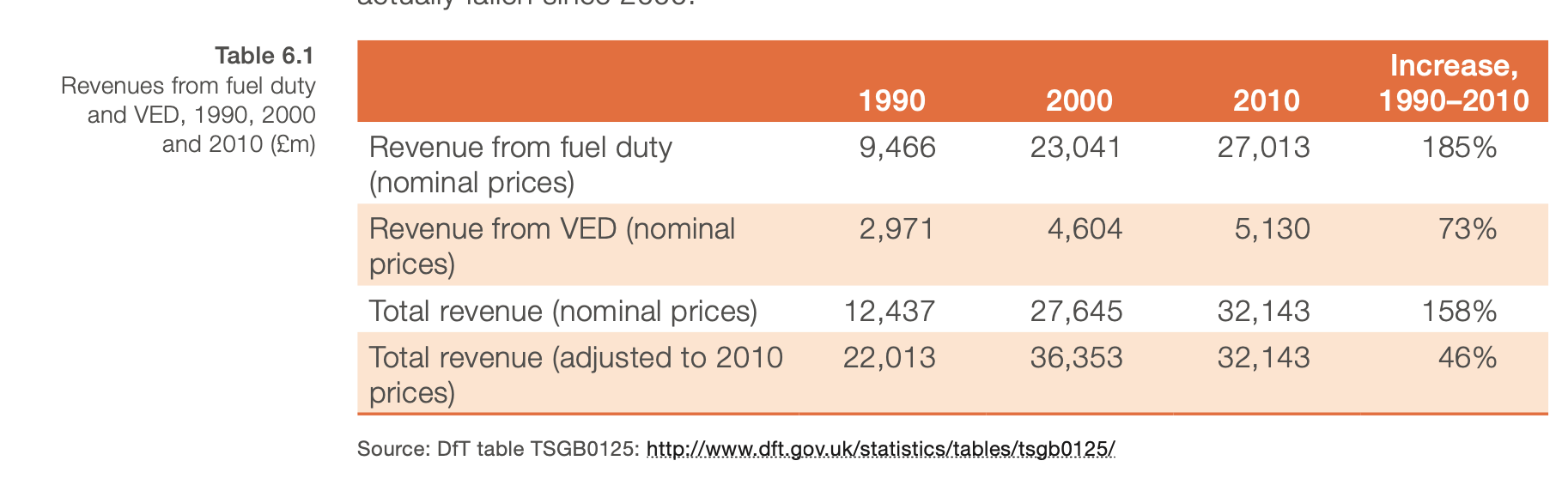
But look at the table posted by Michael748. £5.1bn was raised through V.E.D. in 2010 compared to £27.1bn from fuel duty. That is the problem, it is over five times more important than V.E.D. but is not something which can be fixed on paper.
Fuel duty is 57.95p per litre. That means I am already paying 3.51p per mile, on average, when I ride my bike. That is the money which is being lost which needs to be replaced. That is why road pricing is as near to a like-for-like replacement as you can get.
That is why no one is penalizing the Sleeper for where he lives. Because he is already paying something like 5.2p per mile (assuming an average of 50 mpg) when he goes shopping anyway. So a 5.2p per mile road charge would mean paying exactly the same as now in tax.
The problem is not the idea of charging but how to collect it.