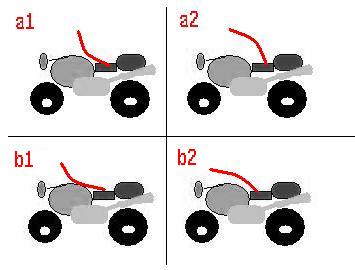
how do you sit on your bike - specifically how do you arch your back.
do you push your chest out (a) or do you hunch over (b)
would this be the same for more upright bikes (1) and sportsbikes (2)
sorry for the crap paint skills, but to help you visualise what i mean:
a1 is an upright bike rider that pushes his chest out (red line is the spine)
a2 is an upright bike rider that hunches over (red line is the spine)
b1 is an sportsbike rider that pushes his chest out (red line is the spine)
b2 is an sportsbike rider that hunches over (red line is the spine)
your back position should be the same for both bikes, the angle of body lean set at the hips and your core actively supporting your posture
‘relatively’ speaking your back should resemble the ‘chest out’ positon as there is a natural curvature to the spine in the lumbar region (although should not be as extreme as you’ve pictured).
hunching over the bars means you’re most likely bearing weight on your hands and elevating your traps, with your head craning upwards. if people have a job/lifestyle that involves sitting down a lot they will be particularly prone to this, as will people who do a lot of weight training without adequate stretching and ‘balance’ between front to back training.
the trapezius muscles (the hits that are hunching) do a few functions including providing stabilisation and control for the neck, move the shoulder blades etc. its probably not hard to see that it will struggle to do those jobs effectively if they are held in an over tensed position, especially for long periods of time. so if by conscious thought you can cause them to relax and yet still perform the function (i.e. ride the motorcycle), why are they hunching at all?
something to consider is whether you believe this muscle group suddenly behaves oddly when on the bike, or does your body tend to this already and it is more evident/exaggerated on the bike, especially if your riding technique may be less than ideal
sitting down and lack of good functional movement tends to weaken the core and cause the issues related to kyphosis. the body is very good at compensating and is trying to rectify the situation by bracing the upper part of the body (the traps). now clearly in the long run this is a bad thing and will lead to complications, but in the short term it works and the body has solved the problem and is letting you carry on. its just survival mechanisms really.
so you can continue to try and deal with the bracing on the upper part of the body, or improve the core and postural strength and remove the body’s need to brace in the first place